I was a damn good lawyer. Twenty years of corporate litigation taught me to spot a bad contract from three floors away and dismantle it before my coffee went cold. Turns out, my talent wasn't from law school. It was genetics. When my grandmother died, she left me the truth: I'm a crossroads demon, born to negotiate deals between desperate mortals and gods who collect souls like trading cards. My instincts, my ability to read people, my nose for loopholes? All part of my supernatural inheritance. Papa Legba showed up at the funeral to tell me my "apprenticeship" was over. Now I can see the soul-deep contracts mortals make when they're out of options, and I'm supposed to facilitate deals between humans and ancient Vodou spirits without question. Yeah, that's not happening. These people don't know what they're signing. They're coerced, desperate, tricked into agreements they can't possibly understand. And I'll be damned—literally—if I'm going to let these gods steamroll mortals who didn't read the fine print. Then there's Kalfou. The dark crossroads. The shadow to Papa Legba's light. He argues for the gods without mercy, believes every contract should be enforced to the letter, and thinks I'm a naive fool. He's also brilliant, infuriatingly articulate, and the only being who can match me in an argument. We clash on every case. Our battles are vicious and intellectual, and I can't decide if I want to strangle him or kiss him. But something's wrong in the divine realm. Souls are disappearing. Contracts are being made with entities that shouldn't exist. And stopping whatever's coming is going to require working with the one god I can't get out of my head. My name is Margot Kane. I'm forty-three, stubborn as hell, and about to remind every god and spirit that before I was a crossroads demon, I was a lawyer. And lawyers don't lose.

CROSSROADS COUNSEL BOOK 1:
I thought I was having a
breakdown when I started seeing glowing contracts written on people's skin. Turns out, I was just coming into my inheritance—and uncovering a conspiracy two centuries old.
My name is Margot Kane, and at forty-three, I was one of the best attorneys in Chicago. Then my grandmother died and left me the truth: I'm a crossroads demon, born to negotiate deals between
desperate mortals and the gods who've been exploiting them for sport.
My first cursed client? A jazz musician who sold his talent to Baron Samedi. Now the death god wants his six-year-old daughter as payment, and I'm supposed to facilitate this nightmare. Then I
find my dead mother's research hidden in my grandmother's things, and everything changes.
Crossroads demons weren't meant to be facilitators. Our purpose is enforcement. We once had the power to nullify predatory contracts, to hold gods accountable, and to protect mortals from divine
tyranny. Until 1823, when the lwa convinced us we'd never had that authority at all. They've been running unchecked ever since.
My mother died trying to restore those powers. Now I have three weeks to finish the job that got her killed before my client's daughter is condemned.
Baron Samedi is watching my every move with that infuriating smirk, waiting for me to fail. Papa Legba warns me I'm walking the same path that claimed my mother's life. And Erzulie—the goddess
who murdered her—is already sharpening her knives.
I didn't go to law school to start a war with the gods. But I'll be damned if I let them keep exploiting mortals with their stipulations and manipulations.
The retainer is steep. The opposing counsel is immortal. And this career change could cost me my soul. But this time? I'm not just defending my client. I'm taking back everything they stole from
us.
For fans of Kim Harrison's The
Hollows and Ilona Andrews' Kate Daniels, CROSSROADS OF THE DAMNED is a snarky, sexy urban fantasy where corporate law meets voodoo politics, and the only thing more dangerous than challenging the
gods is falling for one.
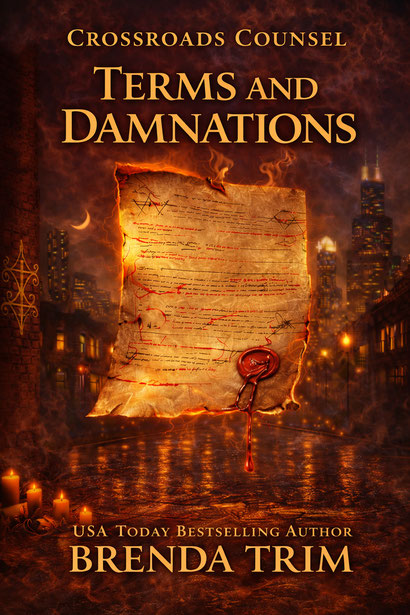
CROSSROADS COUNSEL BOOK 2:
Three months into this nightmare, and I still can't tell my ex-husband why I quit the firm.
"Spiritual contract law" doesn't exactly fit on a LinkedIn profile. Neither does "I can see the threads of fate binding people to their doom." But that's exactly what I do now—I see the deals, the desperate promises, the soul-deep contracts that mortals make when they've run out of options.
My latest client is a surgeon who promised Erzulie Dantor anything to save her son's life. Anything. The goddess of mothers took her at her word, and now she wants the surgeon's hands—literally. Every life she saves from here on out belongs to the goddess. It's elegant. Brutal. And technically ironclad.
But I've found a loophole in the original terms, buried in the way the oath was sworn. If I can prove the contract was made under false pretenses—that the goddess is literally feeding on my client like a parasite—I might be able to renegotiate. The problem? Erzulie Dantor doesn't appreciate being told she's wrong. And Papa Legba is breathing down my neck, reminding me that my job is to facilitate deals, not torpedo them.
Baron Samedi, of course, finds the whole situation hilarious. He keeps appearing at the worst possible moments—in my bathtub, in my car, once memorably in my therapist's waiting room—to mock my "crusade" and place bets on how long until the other lwa crush me. But when Erzulie's followers start targeting me directly, he's the one who shows up with a warning. Not help. Just information. He claims he's protecting his "investment," but there's something in the way he looks at me that makes my skin prickle.
I tell myself it's disgust. It's definitely disgust.
My grandmother never told me that being a crossroads demon would mean choosing between my conscience and my survival. She never mentioned that the gods would start testing me, pushing back, making examples out of mortals who dared to have a demon advocate on their side.
But I've spent twenty years fighting for clients in boardrooms and courtrooms. The venues have changed, but I haven't. And I am not backing down.
Even if it kills me. Even if the god of death himself won't stop watching me like I'm the most interesting thing he's seen in centuries.
For fans of Kim Harrison's The Hollows and Ilona Andrews' Kate Daniels, CROSSROADS OF THE DAMNED is a snarky, sexy urban fantasy where corporate law meets voodoo politics, and the only thing more dangerous than challenging the gods is falling for one.
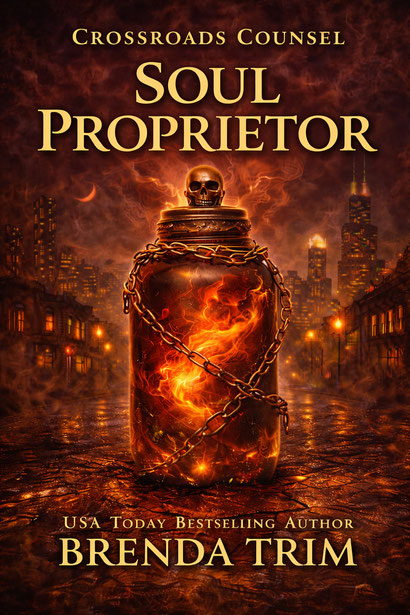
CROSSROADS COUNSEL BOOK 3:
I made Baron Samedi angry. Really angry.
Turns out death gods don't appreciate when you convince their contracted souls to file for breach of contract. Who knew? (Papa Legba knew. He warned me. I didn't listen.)
Now I'm dealing with the fallout: my apartment is haunted by ghede spirits who rearrange my furniture at 3 AM, my coffee tastes like grave dirt, and every mirror shows me exactly how I'll look as a corpse. Subtle, Baron. Real subtle.
But I don't have time for a divine harassment campaign because my new client is an eighteen-year-old college student who inherited her mother's debt to Ayizan—the goddess of markets and initiation. The girl owes seven years of service in the spirit world, starting immediately. She hasn't even finished her freshman year.
The contract is legitimate. The mother knew exactly what she was doing when she traded her daughter's future for her own success. And Ayizan is one of the oldest, most respected lwa in the pantheon—the kind you don't challenge lightly.
But this kid didn't sign anything. She didn't agree to anything. And according to mortal law—the law I actually studied—you can't inherit debt without consent. The question is: does that principle apply in a realm where gods make the rules?
Baron stops haunting me halfway through the case. Just stops. The spirits disappear, my coffee tastes normal again, and for three days I don't see him at all. When he finally shows up, he's different—quieter, watching me work instead of mocking it. He tells me I'm going to get myself killed taking on Ayizan. I tell him to leave if he's just here to discourage me. He doesn't leave. Instead, he stays through my entire negotiation with the goddess, silent backup that I absolutely did not ask for and definitely don't need. Afterward, he tells me I argue like someone who's forgotten gods don't fight fair. I tell him maybe gods should learn. He almost—almost—smiles. It's terrifying.
I'm about to find out if mortal legal principles matter in the divine realm. Even if it means burning every bridge I have with the divine community. Even if it means the god who's been my worst enemy might be turning into something else entirely.
I became a crossroads demon to help people. If the gods don't like it, they can sue me.
Good luck finding a lawyer willing to take that case.
For fans of Kim Harrison's The Hollows and Ilona Andrews'
Kate Daniels, CROSSROADS OF THE DAMNED is a snarky, sexy urban fantasy where corporate law meets voodoo politics, and the only thing more dangerous than challenging the gods is falling for
one.
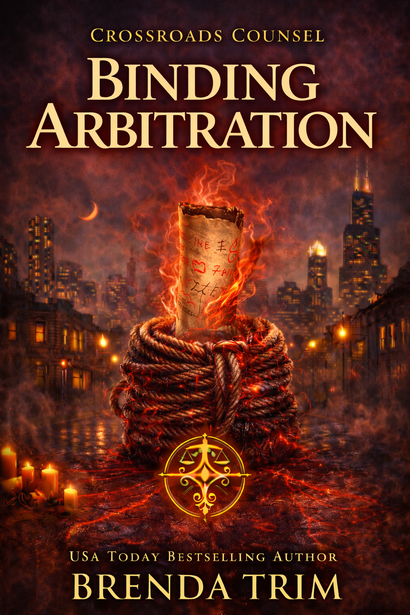
CROSSROADS COUNSEL BOOK 4:
I've been summoned to the crossroads. The real one.
Not a metaphorical meeting or a spiritual negotiation—the actual convergence point where the mortal world and the divine realm intersect. It's like being called before the Supreme Court, except the justices are ancient gods and the courthouse exists in four dimensions simultaneously.
My crime? Disrupting the natural order. Breaking deals. Encouraging mortals to read the fine print. You know, doing my job.
Papa Legba is technically on my side—I'm his crossroads demon, after all, and my success reflects on him. But even he's getting pressure from the other lwa to "manage" me. Baron Samedi is supposed to testify against me, presenting evidence of every deal I've disrupted, every contract I've challenged. It should be simple—we're enemies, after all. He's got plenty of ammunition.
They've given me an ultimatum: take a case that proves I can serve both mortals and gods fairly, or lose my position entirely. The case? A priest who made a deal with Damballah, the serpent god, to bring rain to his drought-stricken village. The rain came. The crops grew. And now Damballah wants what he's owed: the priest's faith. All of it. Every prayer, every devotion, every moment of spiritual connection redirected to the serpent god alone.
If I win, the priest loses his calling. If I lose, I lose everything.
Baron's testimony is devastating and precise—and completely useless to the prosecution. Every "disruption" he describes, he frames as clever legal maneuvering. Every challenge I've made, he calls "creative interpretation." The other lwa are furious. Papa Legba looks shocked. And when I catch Baron's eye across the convergence point, something passes between us that has nothing to do with death or deals or divine politics. Later, he corners me in a space between worlds and tells me I'm making everything complicated. I tell him he's the one who just committed perjury for me. He says gods can't commit perjury, only selective truth-telling. Then he kisses me like he's been thinking about it for months, and I kiss him back like I haven't been lying to myself about wanting exactly this.
We don't talk about it. We can't talk about it. Because this case isn't about the priest—it's about whether a crossroads demon can exist who actually serves mortals instead of just processing their souls.
My grandmother must have known this moment would come. I wish she'd left me better instructions than "trust your instincts and never negotiate on an empty stomach."
Though in fairness, both pieces of advice have proven surprisingly useful lately.